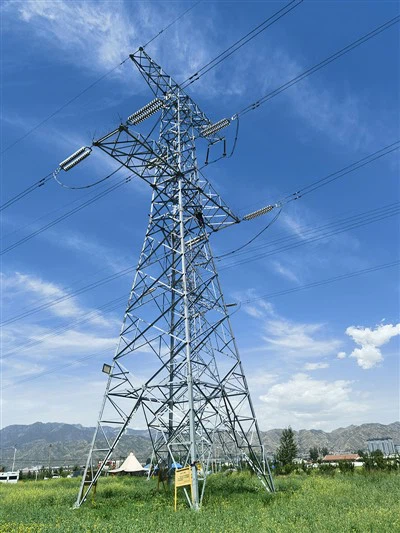
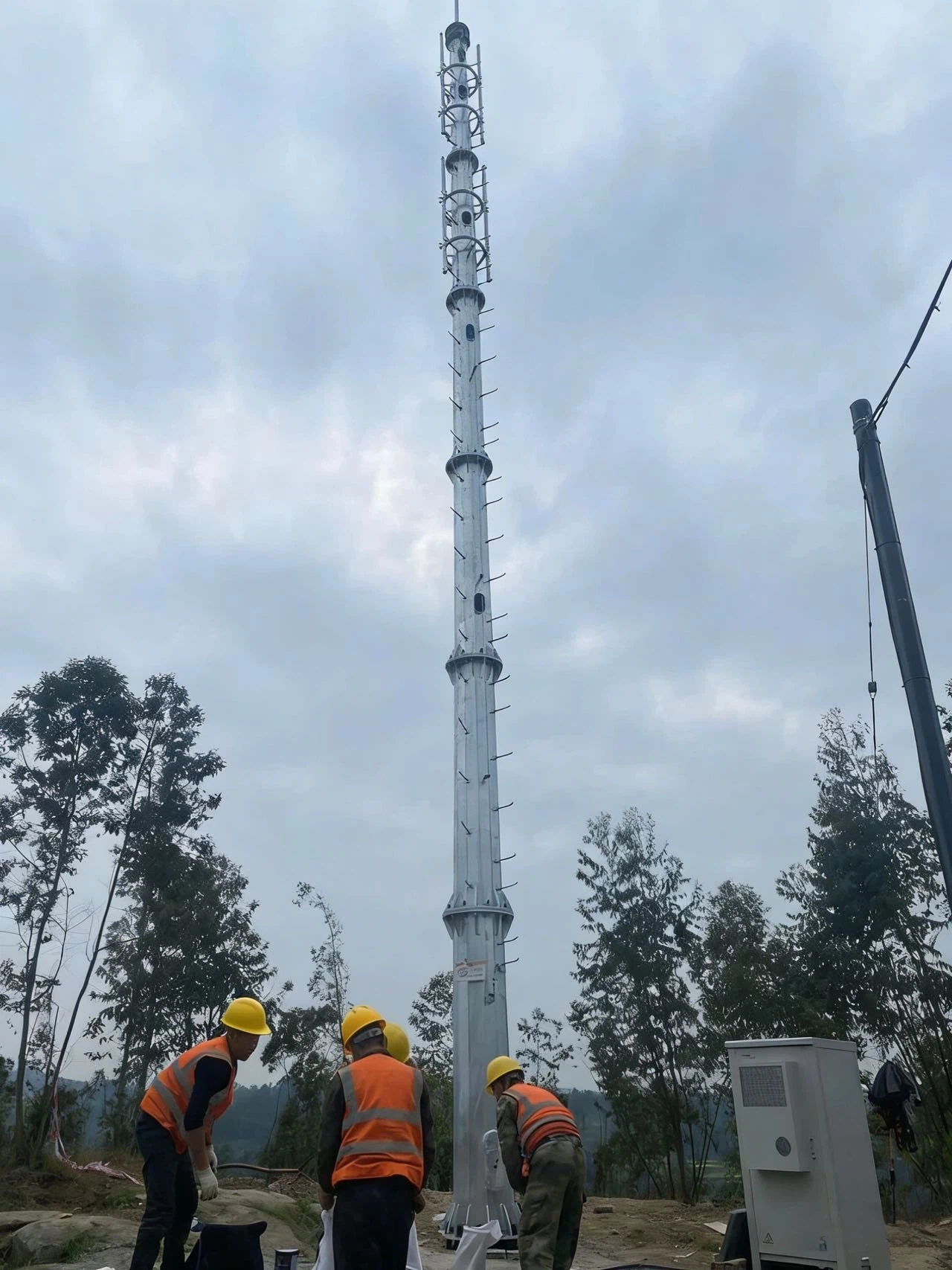
Walk along a high-voltage line and the towers are not all the same. Each shape is built for a different job on the corridor.
Straight towers sit on level runs. They carry only the weight of the conductors, insulators and wind, and they make up about 80 percent of the towers on a typical line. Tension towers come at corners, at river or highway crossings, and at fixed breaks. They take the full pull of the conductors so that a broken wire does not race down the whole span. Corner towers turn the line direction and resist sideways pull. Terminal towers stand at the very ends, where the line meets a substation, and hold the load in one direction.
Height follows the voltage. A 35 kV tower runs 15 to 40 m, a 110 kV tower 20 to 50 m, a 220 kV tower 30 to 60 m, and a 500 kV tower 40 to 80 m, while extra-high-voltage designs reach 60 to 120 m. Every one is an angle-steel lattice, square in section, hot-dip galvanized, and built to GB/T 2694-2018.
Picking the right shape for each position keeps the corridor safe and avoids overbuilding steel where it is not needed. Sections ship knocked-down, ready to erect.